The Hidden Cost of AI-Generated Text in Engineering Workflows
Discover why AI-authored documents can hinder collaboration and what this means for engineers seeking to communicate effectively within their teams.
The Context Challenge of AI-Authored Communication
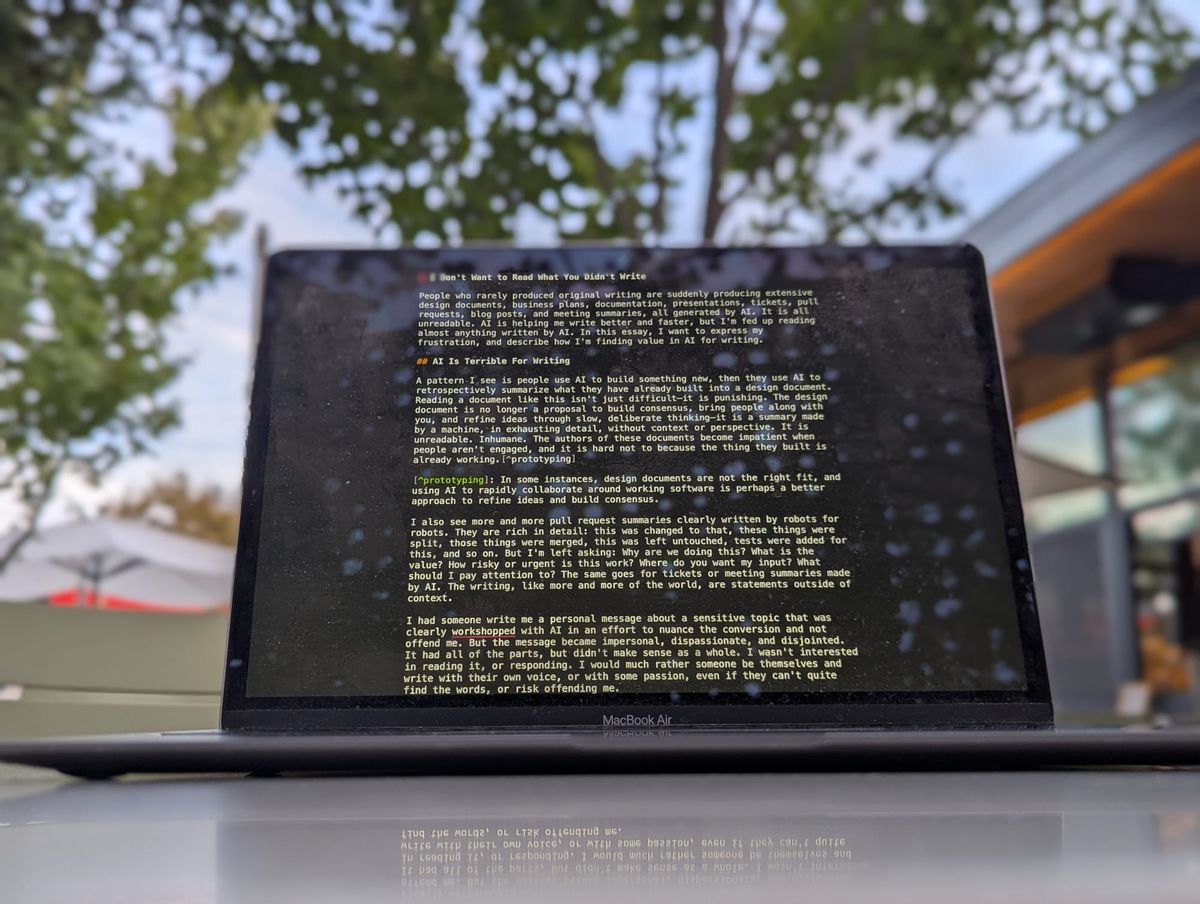
Artificial intelligence tools are increasingly used to generate a wide range of technical documents, from design proposals and pull request summaries to internal documentation and meeting notes. However, blog.colinbreck.com highlights a significant problem: much of this AI-generated content is unreadable to anyone other than the person who prompted it.
The core issue, according to the publication, is a lack of shared context. When an engineer uses AI to summarise something they have already built or understand, they possess the underlying knowledge, the constraints provided, and the artefacts (like source code or logs) that informed the AI’s output. This allows them to quickly discern relevant information. Conversely, a recipient of this AI-generated text lacks this foundational context, forcing them to engage in an exhaustive, line-by-line analysis in an attempt to reconstruct the original meaning. This process is described as punishing, leading to disengagement and a preference for stopping reading entirely. A survey cited by blog.colinbreck.com indicates that 78% of readers cease reading if they suspect an article is AI-assisted or AI-authored, with 71% avoiding the author in the future.
Impact on Software Development and Collaboration
For engineering teams, the prevalence of AI-generated text presents considerable challenges. Design documents, which should facilitate consensus and refinement of ideas through considered discussion, become mere machine-made summaries when AI-generated. These detailed but context-less documents fail to convey the ‘why’ behind decisions or the value of the work, frustrating authors when colleagues remain disengaged. Similarly, AI-written pull request summaries, while rich in detail about code changes, often omit crucial information like the work’s urgency, associated risks, or where reviewer input is most needed.
This loss of contextual nuance extends to broader communication within a team. Crucial discussions or sensitive topics can become impersonal and disjointed when AI is used to craft messages, weakening the interpersonal relationships vital for effective teamwork. For engineers and technical founders, relying on AI to write instead of using their own voice risks eroding the human connection and shared understanding essential for complex problem-solving and innovation.
Strategic Use of AI and Future Outlook
Despite these challenges, blog.colinbreck.com stresses that AI can be a valuable tool when used strategically, not as a replacement for human authorship. The author details using AI extensively while writing an academic paper, but crucially, the AI did not write any lines of the paper itself. Instead, it functioned as an assistant for verification against source code and logs, completing citations, correcting grammar and spelling, simplifying sentences, and even drawing technical diagrams. It proved particularly adept at writing the abstract—the most mechanical part of the paper—because this involves summary and re-presentation, which AI excels at.
Looking ahead, the article points to initiatives like ASD-STE100 Simplified Technical English, a standard designed for clear instruction manuals that is being adapted for AI models. This could improve the clarity of AI-generated runbooks or installation guides. Additionally, tools like Pangram are emerging to detect AI-generated writing. This technology is being used by some organisations to ensure public writing is human-authored, reinforcing the idea that intentional, authentic writing, with its inherent flaws and idiosyncrasies, will become increasingly valued in a world saturated with machine-produced text.